La Pobla de Segur pays tribute to Josep Cubiló i Siurana, political exile and deportee to the Mauthausen camp
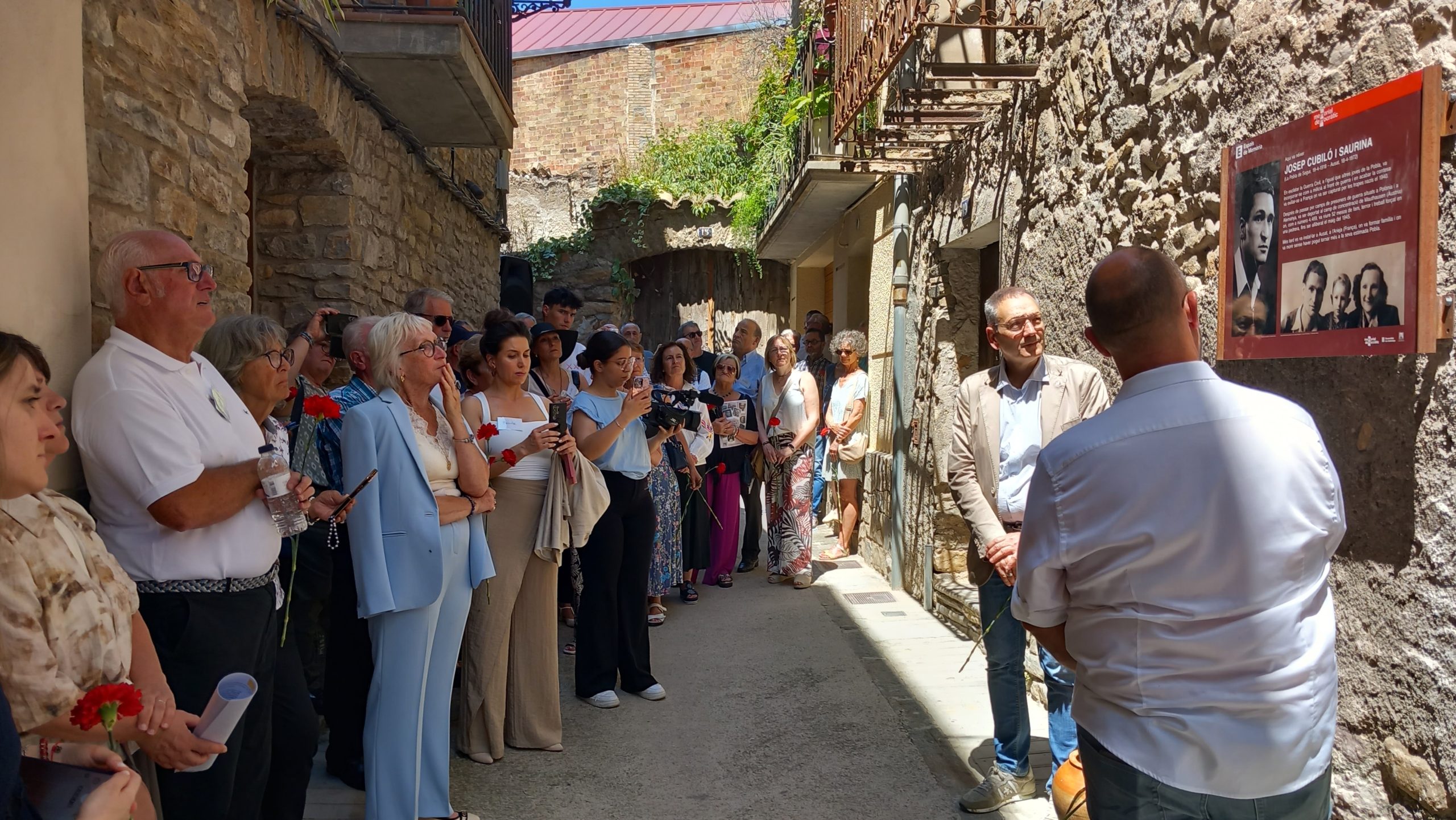
This Saturday, June 28, the City Council of La Pobla de Segur paid tribute to Josep Cubiló Saurina, the only resident of the town who was a prisoner in a Nazi concentration camp. In his honor, a commemorative event was held with a conference on the tribute given by historian Josep Calvet, a commemorative plaque was placed in the house where he was born on Pau Claris Street and a Stolpersteine was installed, as is done with all victims of Nazism.
The tribute event was attended by his children, grandchildren and relatives who came from France, the United States and various parts of Catalonia. In addition to the mayor, Marc Baró, and the rest of the councilors of La Pobla de Segur, the events were chaired by the Government delegate to Alt Pirineu and Aran, Sílvia Romero, and the director of the Memorial Democràtic de la Generalitat, Jordi Font.
Josep Cubiló i Saurina (1918-1972)
Josep Cubiló, born in Pobla de Segur in 1918, volunteered as a militiaman at the start of the civil war. He left his home never to return. After the civil war ended, he went into exile in France where he was in several concentration camps, worked in a Company of Foreign Workers, from where he was captured by the Nazis. After going through a stalag (foreign prison camp) in Poland and another in Germany, in January 1941 he was deported to Mauthausen (Austria) where he became number 4,469 and where he worked in the famous quarry, transporting large loads, suffering terror and blows with sticks from the barracks leaders, watching hundreds of his comrades die, surviving as best he could against such cruelty.
Freedom came to him on May 5, 1945, when American troops liberated the camp. He had suffered 52 months of hunger, terror, and forced labor in inhumane conditions.
With almost half his weight, malnourished and very weak, he was sent to the Lutetia hotel in Paris, where they helped him overcome the trauma he had experienced. After being discharged, he met a Parisian, Huguette Lorouet, with whom he began a new life far from the capital of France.
They settled in Ariège, in the town of Ausat, where he worked in the aluminum factory, formed his own family and where he died on April 18, 1972, at only 54 years old, without having been able to return to his beloved Puebla or without having seen democracy restored in Spain.